
A client who stops paying halfway through an interior project puts a studio in a difficult position. Material is already ordered, carpenters expect their weekly wages, and pushing too hard can turn a delayed payment into a dispute. This guide is about getting paid while keeping the client: what to do on the first day a payment is late, and how to escalate step by step if it stays unpaid.
The short answer
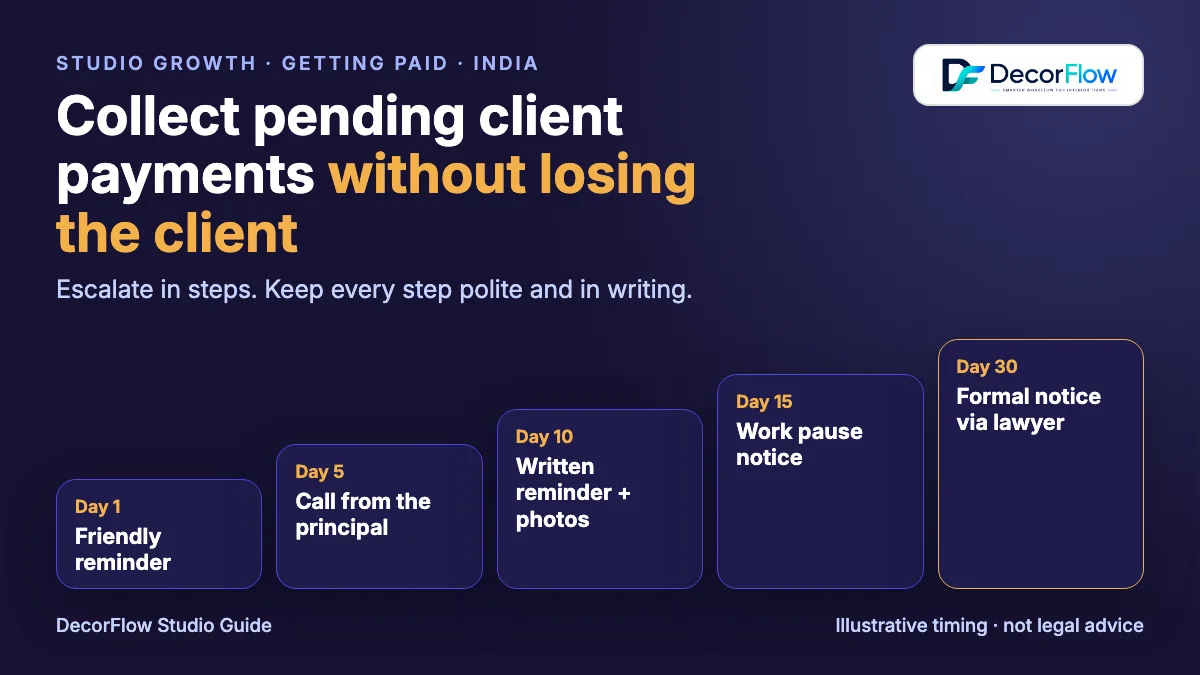
Most late payments are fixed by asking early, clearly and in writing, with the invoice and the finished work in front of the client. Escalate in steps: reminder, call, written reminder, work pause under your contract, formal notice. Keep every step polite and documented. The best fix is prevention: payment stages tied to finished work, agreed before the project starts.
First, find out why the payment is late
The right response depends on the reason. Before sending reminders, check which of these it is:
| Reason | What it looks like | What to do |
|---|---|---|
| Forgot or busy | No reply, no objection | A clear reminder with the invoice attached usually fixes it |
| Cash timing | "Next week", "after my bonus" | Agree a date in writing; consider a part payment now |
| Unclear invoice | Questions about what the amount covers | Resend with the stage deliverable and photos of the finished work |
| Unhappy with work | Complaints about finish, delays or snags | Treat it as a quality issue first: site visit, snag list, dates to fix |
| Scope disagreement | "I thought that was included" | Go back to the signed quotation and change orders |
| Unwilling to pay | Repeated excuses, avoids calls | Move steadily up the escalation ladder |
Clients who are unhappy with the work rarely pay because of reminders. Fix or schedule the snag first, then ask for the payment.
The escalation ladder
Illustrative timing, counted from the invoice due date. Adjust it to your contract and the size of the amount.
| When | Step | Channel |
|---|---|---|
| Due date + 1 day | Friendly reminder | WhatsApp or SMS from your own phone |
| + 5 days | Phone call from the principal or project lead | Call, then a short written summary |
| + 10 days | Written reminder with the invoice, stage deliverable and photos | Email and WhatsApp |
| + 15 days | Work pause notice, if your contract allows it | Email, referring to the payment clause |
| + 30 days | Formal notice for recovery, after speaking to a lawyer | Through your lawyer |
Step 1: the friendly reminder
Assume good faith. Keep it short and attach the invoice.
Hi Priya, a quick reminder that invoice INV-0142 for the wardrobe installation stage (₹2,36,000 incl. GST) was due yesterday. Sharing it again here. Let me know if you need anything from us. Thanks!
Step 2: the call
A call from the principal often gets the real reason. Ask, listen, and agree a specific date. After the call, confirm in writing:
Thanks for the call, Priya. As discussed, you'll transfer ₹2,36,000 for INV-0142 by Friday 13 November. We'll continue with the shutter fixing as planned.
Step 3: the written reminder
Send a fuller message with everything the client needs to pay without asking questions: the invoice, what the stage covered, photos of the finished work, and your bank and UPI details.
Hi Priya, following up on INV-0142 (₹2,36,000 incl. GST), now 10 days overdue. This covers stage 3 of our agreement: wardrobe carcass and shutters installed in both bedrooms (photos attached). Our bank details are below. Could you confirm the payment date? If something about the work needs attention, tell us and we'll schedule a visit this week.
Step 4: the work pause notice
If your contract allows the studio to pause work when a stage payment is overdue, say so calmly, with a date. Pausing is a lever, not a punishment: it stops your exposure growing while you wait.
Hi Priya, INV-0142 (₹2,36,000) is now 15 days overdue. Under clause 6 of our agreement, work after a missed stage payment continues once the payment is received. We'll pause site work from Monday 23 November if the payment is not received by then, and restart within two working days of payment. We'd much rather keep going, so please let me know if we can help.
Don't pause without a contract clause, and don't remove material already installed. Both can turn a payment delay into a dispute you are on the wrong side of.
Step 5: the formal notice
If the client still doesn't pay, speak to a lawyer. Lawyers answering similar questions on Indian legal Q&A sites commonly suggest a legal notice giving the client a deadline to pay, followed by a civil recovery suit if needed, supported by the contract, invoices and written communication. If the client gave a cheque that bounced, ask your lawyer about it immediately, because strict time limits apply.
If your studio is registered as a micro or small enterprise (Udyam), the MSMED Act sets deadlines for payment and interest on delayed payments, with complaints through the Ministry of MSME's facilitation process. Ask your lawyer or CA whether and how it applies to your clients.
Keep the record clean from day one
Whichever step you reach, what helps most is a clear record:
- Signed quotation or agreement, with payment stages and the work-pause clause
- Approved change orders for anything added later
- Each invoice tied to a named stage, with the date the stage was completed
- Photos of finished work at each stage
- Every reminder in writing, even after a phone call
- Payments received, with dates and transaction references
In DecorFlow, invoices track whether each one is paid, partly paid or unpaid, and the Outstanding report shows what each client owes. Clients can submit a payment claim from the client portal with the payment mode (bank transfer, UPI, cheque or cash) and a receipt, which your team verifies against the bank. One-tap WhatsApp from a client record opens your own WhatsApp to send a reminder. Reports and full client portal access are included from the Starter plan. See invoicing and payments.
Prevention: design the payment stages so this happens less
Most overdue payments trace back to payment stages that weren't tied to visible work, or a large stage that came due before the client could see what they were paying for. Our payment terms guide covers how to structure stages and the contract clauses that protect them. Three habits matter most:
Never start a stage before the previous stage's payment is in.
Collect the material payment before placing large orders, so your working capital doesn't fund the client's project.
Send the invoice the day the stage is finished, with photos, while the client can see the work.
Common questions
Sources
LawRato: non-payment for interior work done for a client (lawyer answers), checked 25 Oct 2026
BIID: what to do when your client doesn't pay, checked 25 Oct 2026
SCC Online: interest under section 16 of the MSMED Act, 2006, checked 25 Oct 2026