
Every interior designer in India has heard the story, or lived it: a client signs an agreement, pays an initial deposit, and promises that "money will never be an issue." Six weeks later, 3D views have been revised five times, custom carpentry is already being assembled on site, and the studio is chasing the homeowner for a ₹3,00,000 disbursement just to pay the plywood dealer and weekly carpenter wages.
Payment trouble on residential sites rarely stems from malice. It happens because studios tie payments to calendar dates instead of verifiable physical work, or because they front-load costs and fund client materials out of their own working capital. When a payment gate lacks an unambiguous deliverable, clients feel anxious, contractors stop work, and cash flow breaks down. Structuring clear interior design payment terms backed by a milestone schedule protects your studio and gives the homeowner full confidence at every stage.
Why interior payment schedules fail: the calendar trap vs the work gate
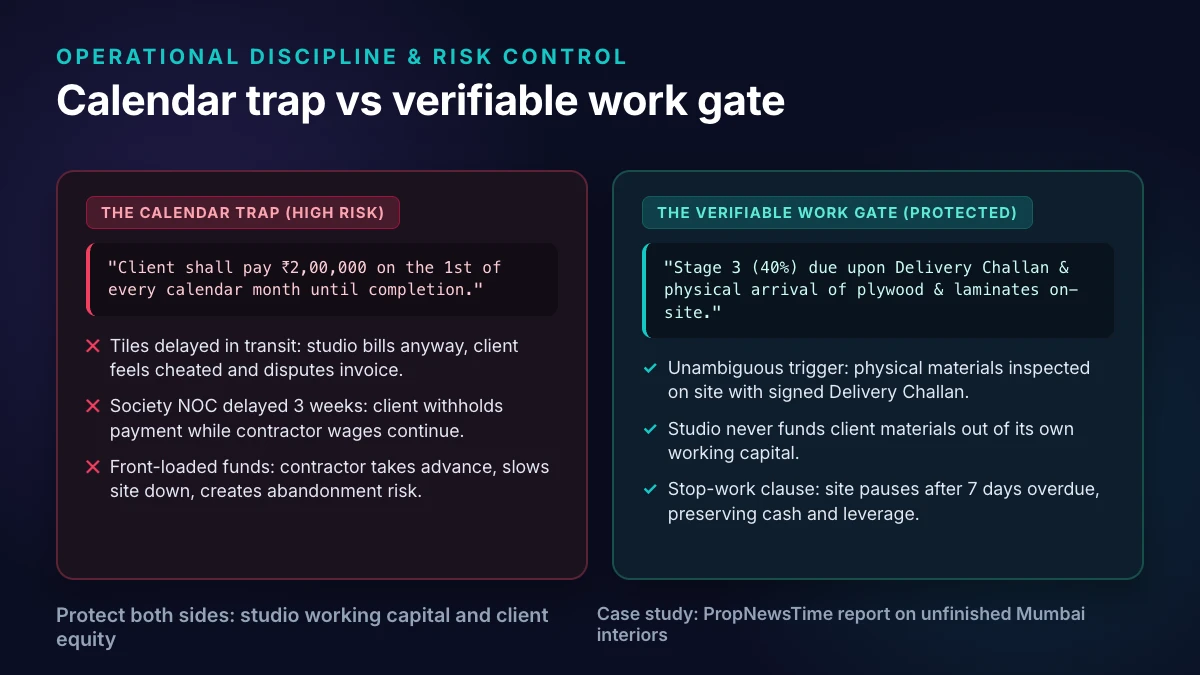
The single most common mistake in Indian interior contracts is calendar-based billing. An agreement that specifies "₹2,50,000 on the 1st of every month" treats a complex civil and carpentry fit-out like an office rental. On real apartment sites, calendar dates bear almost no relationship to physical progress.
Why calendar billing breaks down on Indian apartment sites
An apartment site in Bengaluru, Mumbai, or Gurgaon faces constant external friction. Society management committees restrict noisy core cutting and tile demolition to narrow four-hour windows. Freight elevators break down or get hogged by movers. Specialised Italian marble or charcoal louvres get held up in transit across state borders. When an arbitrary calendar date arrives while the site is visibly incomplete, the client feels cheated if an invoice is raised.
Conversely, if the client withholds a calendar payment because plastering took longer than expected, the studio is suddenly forced to pay carpenter daily wages and hardware vendors out of pocket. Tying payment terms strictly to verifiable physical milestones eliminates this friction entirely. If the stage deliverable is not complete, no invoice is due; once the deliverable is verified on site, payment is mandatory.
The risk of front-loading: lessons from Mumbai's incomplete projects
In a widely discussed investigative report by PropNewsTime, luxury apartment owners across Mumbai's upscale developments revealed paying crores of rupees to interior fit-out firms who completed only basic preliminary work and then abandoned the sites. Homeowners had signed contracts with heavily front-loaded payment structures, clearing 50% to 70% of the contract value before major joinery or electrical work even commenced.
Because police authorities routinely treat partially completed contracts as civil disputes rather than criminal fraud, homeowners were left stranded without leverage. For design practices, this case underscores an essential truth: front-loading is not a sign of financial security. When a contractor takes excessive cash ahead of progress, discipline erodes. Balanced, stage-by-stage milestone gates protect the client against abandonment while ensuring the studio never finances client procurement.
The 5 core payment gates of an interior project
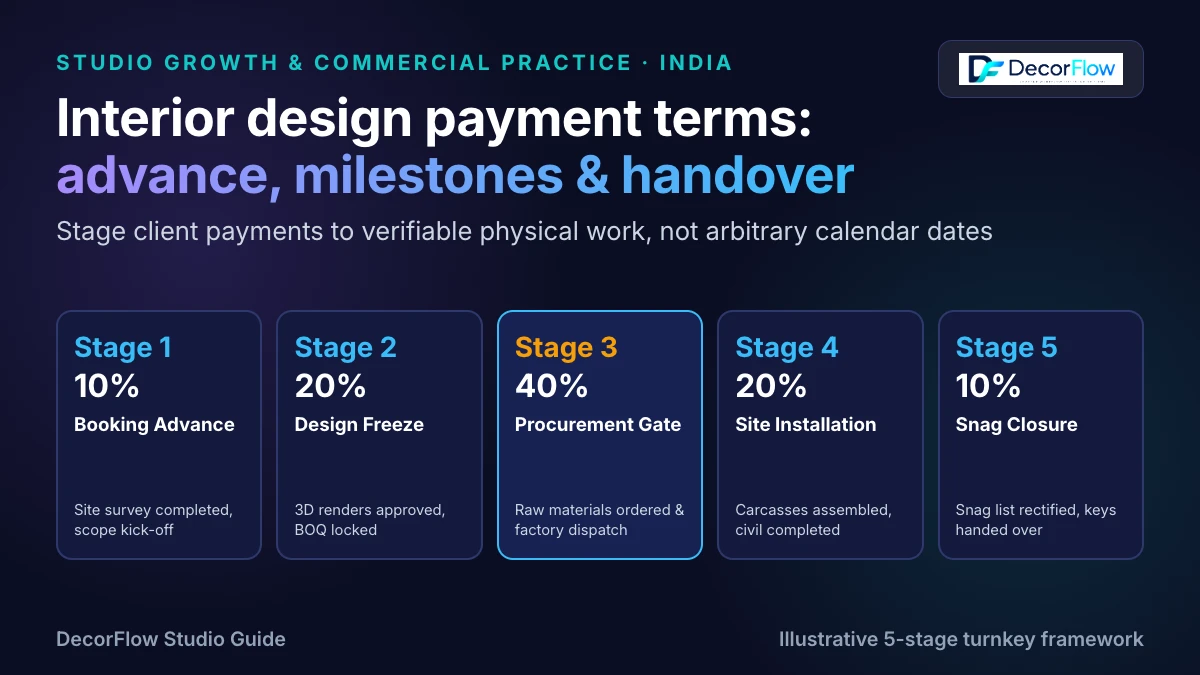
A standard residential turnkey project (combining design, material supply, and site execution) divides cleanly into five commercial payment gates. Each gate corresponds to a concrete shift in operational liability.
Gate 1: Booking advance and survey kick-off (10%)
Informal industry sources like ARCH College of Design & Business (archedu.org) cite initial booking advances between 10% and 20% for residential design work. Because India has no statutory regulator like RERA for interior fit-out contracts, booking percentages vary by studio capitalization. A 10% booking advance is standard for turnkey residential work.
This initial sum mobilises your team. It covers comprehensive on-site laser measurements, electrical distribution board (DB) clearance audits, ceiling beam drop mapping, and the preparation of initial 2D conceptual space plans. The work does not involve purchasing raw materials. If a client cancels during early concept discussions, the 10% booking fee compensates the studio for design time and measured surveys.
Gate 2: Design freeze and BOQ sign-off (20%)
The second gate is billed once 3D renders, material mood boards, and the detailed Bill of Quantities (BOQ) are frozen. Cumulative collections now reach 30%. At this stage, every laminate code, plywood grade (BWR vs BWP Marine), edge-banding thickness, and hardware specification (Hettich, Hafele, or Blum) is locked in writing.
Never purchase materials before this gate is cleared. When a client signs off on the BOQ and clears Gate 2, you have both legal approval of the design and the financial commitment needed to issue purchase orders to timber depots and factory fabricators.
Gate 3: Raw material procurement and factory dispatch (40%)
This is the single largest milestone in any interior project. In turnkey contracts, raw materials (commercial plywood, veneer, laminate sheets, acrylic, and hardware) represent 40% to 50% of the entire project budget. Studio margins cannot absorb this cost.
Gate 3 is triggered when purchase orders are placed and factory carcasses or raw sheets are ready for delivery to the site. For modular factory joinery, this is the pre-dispatch gate: carcasses and shutters must never be loaded onto delivery trucks before Gate 3 funds are received and cleared in your bank account. Once materials enter the client's apartment, you lose custody of the goods.
Gate 4: Site installation and civil framework (20%)
Cumulative payments now reach 90%. This gate is billed when heavy on-site installation reaches substantial completion. For modular projects, this means all carcasses are fixed, level, and plumb, and shutter alignment has begun. For on-site carpentry, it means framing is complete, false ceilings are sheeted and taped, electrical wiring has been pulled to switch boxes, and base coats of putty have been applied.
At 90% collection, the studio has recovered all material expenses, vendor bills, and carpenter wages up to that point. The project is fully solvent, and only fine detailing, countertop setting, electrical fixtures, and final paint coats remain.
Gate 5: Snag list closure, handover and retention release (10%)
The final 10% is the retention amount. It is released only after a joint walkthrough inspection, rectification of recorded snag list items (shutter adjustments, drawer alignment, paint touch-ups, silicone beadings), deep cleaning, and the physical handover of keys and warranty cards.
Retaining 5% to 10% gives the client confidence that minor defects will be rectified promptly. For the studio, holding back final handover until the snag list is signed off ensures you are not left pursuing unpaid balances after the family has moved in.
Comparing 4 milestone payment structures in Indian studios
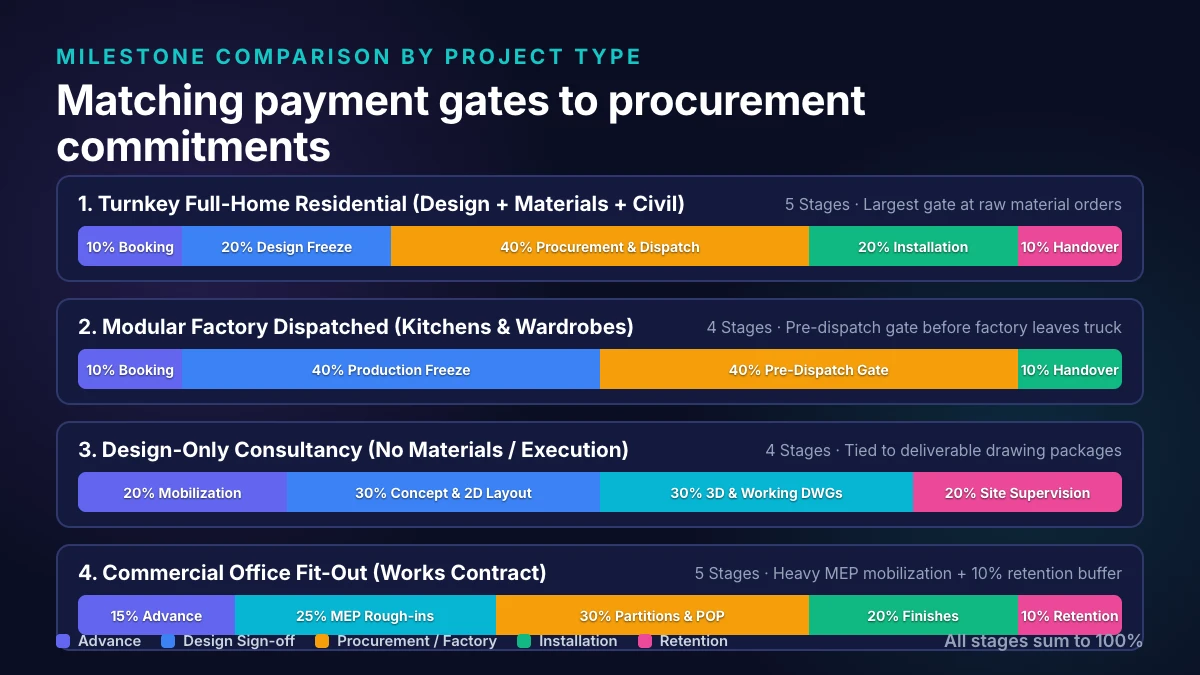
Not every interior project is a turnkey residential fit-out. Modular specialists, design consultants, and commercial office contractors operate under distinct cash flow cycles and procurement liabilities. The table below compares the four most common milestone structures used across Indian practices.
| Project Type | Advance Gate | Design Freeze Gate | Procurement Gate | Execution Gate | Handover / Retention |
|---|---|---|---|---|---|
| 1. Turnkey Residential (Design + Supply + Civil) | 10% (Booking & site survey) | 20% (3D visual approval & BOQ lock) | 40% (Material orders & factory release) | 20% (Carcass install & civil rough-in) | 10% (Snag clearance & key handover) |
| 2. Modular Interiors (Kitchens & Wardrobes) | 10% (Site measurement booking) | 40% (Production drawings & factory lock) | 40% (Pre-dispatch gate at factory gate) | — (Integrated into pre-dispatch) | 10% (Shutter alignment & site handover) |
| 3. Design-Only Consultancy (No Contracting) | 20% (Mobilisation & survey kick-off) | 30% (2D layout & moodboard sign-off) | — (Not applicable to design) | 30% (3D visualisations & GFC drawings) | 20% (Site supervision & final sign-off) |
| 4. Commercial Office Fit-Out (Works Contract) | 15% (Mobilisation advance) | — (Tender drawings pre-agreed) | 25% (HVAC, fire & MEP rough-ins) | 50% (Partitions, ceiling & finishes) | 10% (DLP retention: 5% snag, 5% at 6 mo) |
Worked example: milestone cash flow on an illustrative ₹12L 3 BHK turnkey project
To see how the numbers reconcile across an execution timeline, consider an illustrative 3 BHK apartment fit-out with a contract base value of ₹12,00,000 (exclusive of GST). In turnkey residential contracts combining goods and services, works contracts attract a flat 18% GST under SAC 9954. All figures below are illustrative to demonstrate mathematical reconciliation.
| Stage | Milestone Name | Share % | Base Amount | GST (18%) | Milestone Total | Cumulative Paid |
|---|---|---|---|---|---|---|
| Stage 1 | Booking Advance & Site Survey | 10% | ₹1,20,000 | ₹21,600 | ₹1,41,600 | ₹1,41,600 (10%) |
| Stage 2 | Design Freeze & Signed BOQ | 20% | ₹2,40,000 | ₹43,200 | ₹2,83,200 | ₹4,24,800 (30%) |
| Stage 3 | Procurement & Factory Dispatch | 40% | ₹4,80,000 | ₹86,400 | ₹5,66,400 | ₹9,91,200 (70%) |
| Stage 4 | Carcass Assembly & Civil Works | 20% | ₹2,40,000 | ₹43,200 | ₹2,83,200 | ₹12,74,400 (90%) |
| Stage 5 | Snag List Closure & Handover | 10% | ₹1,20,000 | ₹21,600 | ₹1,41,600 | ₹14,16,000 (100%) |
| Total | Turnkey Contract Value | 100% | ₹12,00,000 | ₹2,16,000 | ₹14,16,000 | ₹14,16,000 |
Notice how the cash flow matches project expenditure. Before ordering ₹4,50,000 worth of plywood, laminate, and hardware from your suppliers at Stage 3, you have collected ₹4,24,800 across Stages 1 and 2, and you raise the Stage 3 invoice for ₹5,66,400. You never spend your firm's capital to fund a homeowner's kitchen.
What goes in the contract: 6 protective payment clauses
A milestone schedule is only as strong as the legal terms governing it. Rather than relying on informal WhatsApp promises, incorporate these six standard operational clauses into your client agreement. For a full clause review, inspect our Turnkey Contract Checklist ("Set payment stages") and adapt the wording with your legal counsel.
1. Define verifiable physical completion criteria
Never write vague payment conditions such as "due when client is satisfied with framing." Client satisfaction is subjective; a physical deliverable is not. Define exact objective criteria: "Stage 4 invoice is triggered upon completion of gypsum false ceiling board installation, application of jointing compound, and delivery challan sign-off for modular kitchen carcasses."
2. The stop-work and demobilisation clause
What happens when an invoice remains unpaid? Without a contractual stop-work clause, halting work on site can put your studio in breach of completion timelines. Include explicit language:
3. Change order pricing in rupees and working days
Scope creep destroys payment schedules. When a client requests extra wall panelling or changes tile layouts mid-execution, never say "we will settle the difference at final billing." Accumulating variations until handover guarantees a dispute over the final 10%. Every scope alteration must be documented as an approved change order detailing the net rupee impact and timeline impact in days before work starts, billed with the nearest milestone.
4. Snagging rectification window and retention release
Clients often attempt to withhold the entire final milestone over a minor scuff mark or a missing switch plate. Set a formal snagging procedure: within three days of substantial completion, a joint walkthrough will be conducted to record a single, agreed snag list. The studio has 10 working days to rectify those specific items. Once closed, the retention payment is due immediately. Additional requests raised after the joint walkthrough do not delay release of the final milestone.
5. Explicit GST treatment and tax invoice timing
All quotations and milestone amounts must explicitly state whether they are inclusive or exclusive of GST. State the applicable SAC code (SAC 9954 for composite works contracts, SAC 9983 for standalone architectural/design consultancy) and clarify that formal tax invoices will be issued upon clearance of each payment. Clarify that statutory tax rates are determined by government notifications and any changes will reflect on outstanding milestone billings.
6. Exclusions: society and builder deposits
Apartment residential welfare associations (RWAs) and builders frequently demand refundable construction deposits ranging from ₹25,000 to ₹1,00,000, along with non-refundable debris removal fees. Make it explicitly clear in your contract that society deposits, building access permits, and municipal permissions are the client's direct responsibility and are excluded from the project contract value.
Managing client payments: invoicing, portal claims and receipt verification
Drafting clear payment terms is only half the battle; managing receipts and reconciliations is the other. In many design practices, collections remain chaotic: homeowners send screenshots of UPI transfers on WhatsApp, transfer NEFT payments without mentioning the project ID, or hand cash to a site supervisor who forgets to log it. When accounting records don't match bank statements, milestone gates stall.
In DecorFlow, milestone billing is integrated directly into the financial workflow. Studios generate GST-ready milestone invoices showing itemised breakdowns, tax codes, prior disbursements, and exact balance due figures.
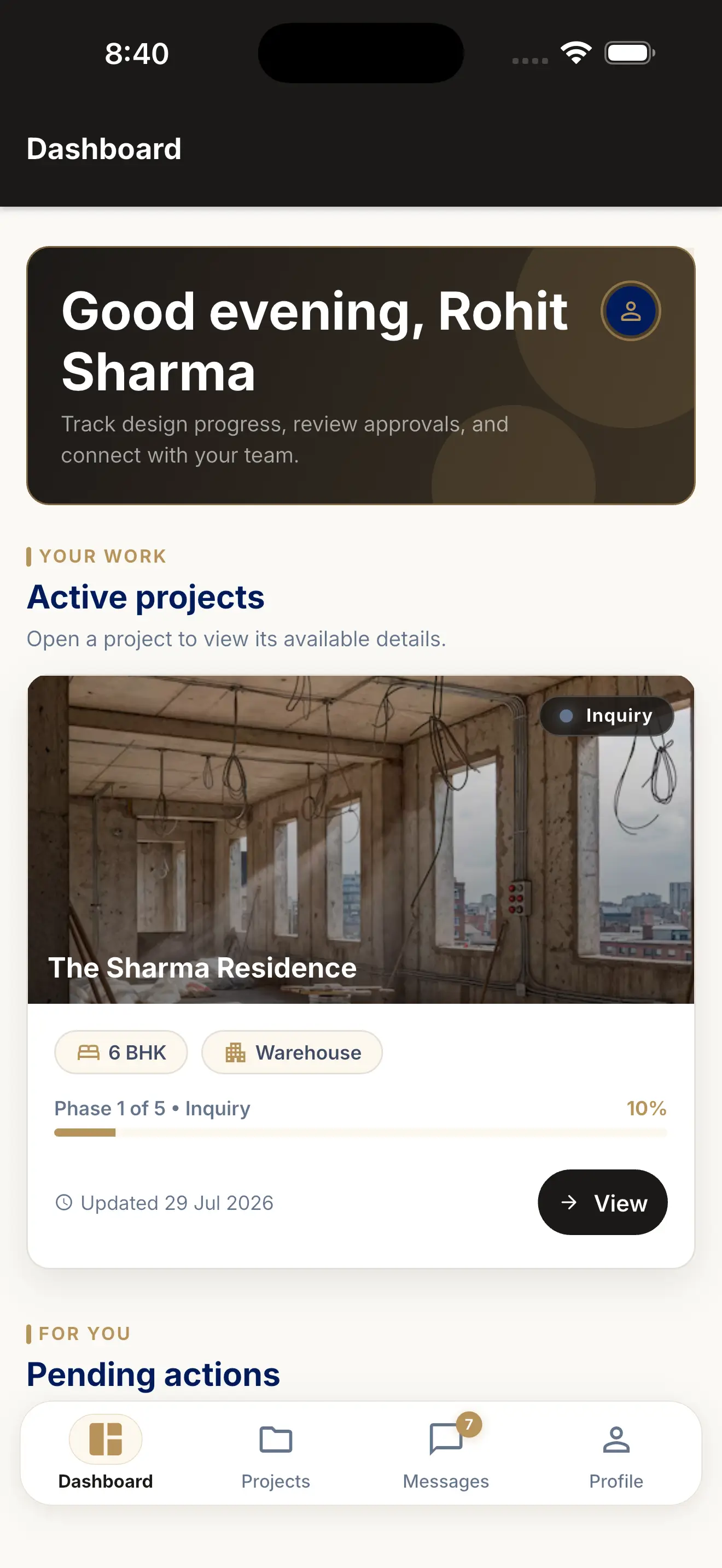
Through the interactive Client Portal, homeowners can log external payments made to your studio—whether via Bank Transfer (with UTR number), UPI (with transaction reference), Cheque, or Cash—and upload a receipt screenshot or bank acknowledgment. The studio accounts team reviews the submitted claim, verifies the funds in the firm's bank account, and confirms the transaction. The invoice balance updates automatically, keeping both client and studio perfectly aligned.
Operational checklist before issuing payment terms
- Verify that every milestone trigger is tied to an objective physical deliverable, not a calendar date.
- Ensure Gate 3 (procurement) is cleared before raw materials are dispatched or modular production begins.
- Include a clear stop-work clause extending project timelines day-for-day if invoices remain unpaid past 7 days.
- State whether quotation rates are exclusive or inclusive of GST, specifying the applicable SAC code (9954 or 9983).
- Confirm that society security deposits and builder permissions are explicitly excluded as client liabilities.
- Specify that change orders will be priced in rupees and working days and signed off before variation work starts.
- Provide clear bank transfer (NEFT/RTGS/IMPS) details and UPI IDs registered to your corporate entity, never personal accounts.