
GST questions come up on almost every interior project in India. Is the design fee taxed differently from the turnkey work? Which SAC code goes on the invoice? Why did one client get CGST and SGST while another got IGST? This guide answers those questions the way a studio owner needs them answered: what to charge, what to print on the invoice, and what to confirm with your CA.
The short answer
For most interior work in India the GST rate is 18%. What changes from job to job is the type of supply (a design service or a works contract), the SAC code on the invoice, and whether you charge CGST + SGST or IGST, which depends on where the property is.
| Situation | What it usually is | SAC commonly used | Rate |
|---|---|---|---|
| You only design: drawings, 3D views, site visits, no materials supplied | Design or consultancy service | 998391 or 9983 (sources differ) | 18% |
| You design and execute, supplying materials and labour for fit-out | Works contract (a composite supply treated as a service) | 9954 (construction services) | 18% |
| You supply loose furniture or decor only, delivered, not installed as part of a works contract | Supply of goods | HSN of each item | Rate of each item |
Sources reviewed in October 2026 put both design consultancy and interior works contracts at 18%. One guide notes that after the rate changes effective 22 September 2025 (Notification 09/2025-Central Tax (Rate)), all works contracts attract a flat 18%; the earlier 12% concession had applied to government and specified works, not private homes or offices.
Design fee or works contract: why the difference matters
The CGST Act defines a works contract (section 2(119)) as a contract for building, construction, fabrication, erection, installation, fitting out, improvement, modification, repair, maintenance, renovation or alteration of immovable property, where transfer of property in goods is involved. Schedule II treats it as a supply of services.
In plain terms: if your studio builds the wardrobes on site, lays the false ceiling, does the electrical and painting and supplies the board, laminate and hardware, you are usually supplying a works contract. If your studio hands over drawings and the client hires the carpenters and buys the material, you are supplying a design service.
Why studios get this wrong
One contract, two invoices, no explanation. A turnkey studio raises a "design fee" invoice and a separate "execution" invoice for the same job without the contract making clear whether these are separate supplies.
Material shown separately. Some studios split "material" and "labour" on the invoice and tax them at different rates. A works contract is one composite supply; ask your CA before splitting it.
Client-purchased items. When the client buys the modular kitchen or appliances directly from a brand, that is not part of your supply, so it should not appear on your tax invoice. Note it as client-supplied in the BOQ instead.
If your contract is a single turnkey agreement, your CA may treat the design element as part of the works contract. If you sign a design agreement first and an execution agreement later, they may be separate supplies. The contract wording drives the answer, which is why it is worth a 20-minute conversation with your CA before your next turnkey job.
SAC codes: show the disagreement, then decide with your CA
SAC is the Services Accounting Code printed against each service line on a tax invoice. For interior studios, the sources do not agree on design-only work:
Design or consultancy only: busy.in lists interior design consultancy under SAC 998391 at 18%. Other guides use the broader group 9983 (other professional, technical and business services). Both appear in practice.
Works contract (design and execute): SAC heading 9954 (construction services), at 18%, is the consistent answer across the sources we reviewed.
We have deliberately not picked one code for design-only work. Choose it with your CA, then use the same code consistently on every invoice and in your GST returns.
CGST + SGST or IGST: place of supply for interior work
This is the question that confuses the most invoices. The type of GST you charge depends on whether the supply is intra-state (CGST + SGST, split equally) or inter-state (IGST). That in turn depends on the place of supply.
For services directly in relation to immovable property, section 12(3)(a) of the IGST Act sets the place of supply as the location of the property. The section names architects and interior decorators among the services it covers. So for most interior work, the place of supply is the site, not the client's billing address.
| Your studio is in | The site is in | Charge |
|---|---|---|
| Karnataka | Karnataka | CGST 9% + SGST 9% |
| Karnataka | Telangana | IGST 18% |
| Maharashtra (client lives in Dubai) | Maharashtra | CGST 9% + SGST 9% (the site is in India) |
Commentators note that a mere connection with a property is not enough; the service must be directly in relation to it. Pure advisory work that is not tied to a specific site may fall under the general rule instead, so check unusual cases with your CA.
Worked example: two invoices from a Bengaluru studio
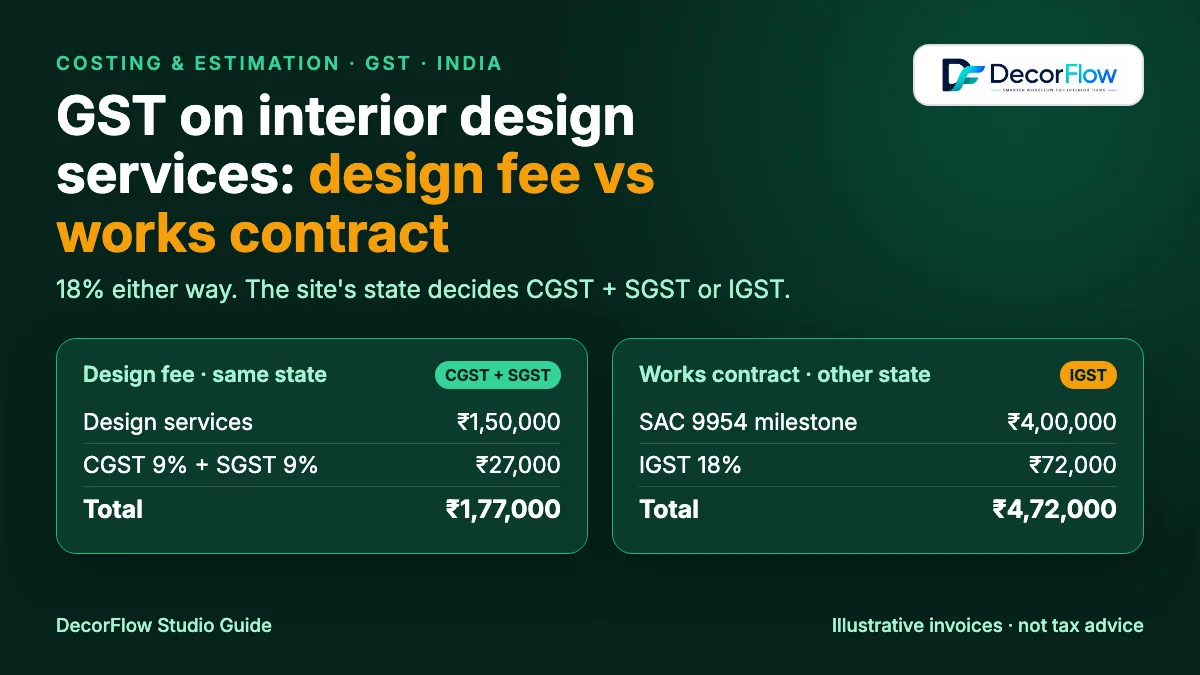
Illustrative figures. A studio registered in Karnataka has two jobs this month.
Invoice 1: design-only fee for an apartment in Bengaluru
| Line | Amount |
|---|---|
| Interior design services, 3 BHK, Whitefield (SAC as agreed with your CA) | ₹1,50,000 |
| CGST @ 9% | ₹13,500 |
| SGST @ 9% | ₹13,500 |
| Invoice total | ₹1,77,000 |
The site is in Karnataka and so is the studio, so the supply is intra-state.
Invoice 2: turnkey milestone for a villa in Hyderabad
| Line | Amount |
|---|---|
| Works contract: carpentry and false ceiling, milestone 3 of 5, Gachibowli villa (SAC 9954) | ₹4,00,000 |
| IGST @ 18% | ₹72,000 |
| Invoice total | ₹4,72,000 |
The client may live in Bengaluru, but the villa is in Telangana, so the place of supply is Telangana and the supply is inter-state: IGST, with Telangana shown as the place of supply on the invoice.
What a GST invoice from an interior studio should show
Rule 46 of the CGST Rules lists what a tax invoice must contain. For interior studios, check these every time:
- Your studio's legal name, address and GSTIN
- A unique, consecutive invoice number and the invoice date
- Client's name and address, and the client's GSTIN if the client is registered (for example, a company fitting out an office)
- Site address, and the place of supply with the state name
- Description of the work and the SAC (or HSN for goods)
- Taxable value after any discount
- GST rate and amount, split as CGST + SGST or shown as IGST
- Whether tax is payable on reverse charge (usually no for interior work)
- Signature or digital signature of the studio
Most invoice mistakes in studios come from three fields: the wrong place of supply on inter-state jobs, a missing client GSTIN on office fit-outs, and SAC codes that change from one invoice to the next.
Quotations: show GST the way the client will understand it
A quotation is not a tax invoice, but clients compare quotations on the final number. Decide how GST appears before you send it:
| Quotation style | What the client sees | Good for |
|---|---|---|
| GST exclusive | Line rates before tax, GST added at the bottom | Office fit-outs and clients who claim credit |
| GST inclusive | Rates that already include GST | Homeowners who want one all-in price |
| Itemised | GST shown against each line | Large turnkey quotations where clients query lines |
Whichever style you use, write "GST @ 18% extra" or "inclusive of GST" in plain words on the first page. Quotations that leave this unclear create the most arguments at the first invoice. Our BOQ format guide covers how GST sits alongside internal cost and client rates.
In DecorFlow, quotations have a tax mode (exclusive, inclusive, itemised, or hidden from the PDF), and invoices are GST-ready with CGST + SGST or IGST and HSN/SAC codes on each line. See quotation software and invoicing.
Input tax credit: what to ask your CA
Input tax credit (ITC) is where many studios hear conflicting advice. Two points from the sources are worth raising with your CA:
Section 17(5)(c) of the CGST Act blocks ITC on works contract services for the construction of immovable property, which includes fit-outs, except where the service is an input for a further supply of works contract service. Your client fitting out its own office generally cannot claim the credit on your works contract invoice.
Because of that exception, a studio supplying works contracts may be able to claim credit on works contract services it buys in (for example, a sub-contracted false ceiling team) and on goods used in its outward works contract. Confirm what applies to your contracts before you rely on it.
A GST checklist before your next turnkey job
- Contract says clearly whether design and execution are one supply or two
- SAC codes agreed with your CA and saved as defaults
- Quotation states GST inclusive or exclusive on page one
- Place of supply set from the site address, not the billing address
- Client GSTIN collected for office and commercial jobs
- Client-purchased items listed as exclusions, not billed
- Milestone invoices numbered consecutively and dated when the stage is complete
Common questions
Sources
taxclue.in: GST on works contract (Notification 09/2025-CT(R), section 2(119), section 17(5)), checked 25 Oct 2026
busy.in: GST on interior work (SAC 998391 and 9954 at 18%), checked 25 Oct 2026
cggst.com: text of section 12(3), IGST Act, checked 25 Oct 2026
BCAJ: place of supply for immovable property based services, checked 25 Oct 2026