
Most articles about interior designer fees in India are written for homeowners comparing quotes. This one is written for the other side of the table: the studio owner deciding how to charge. The fee model you pick decides when cash comes in, who pays for scope creep, and whether the client trusts the number.
The short answer
Indian studios mostly charge in one of three ways: per square foot, a percentage of project cost or a lump sum. Per square foot is easy to quote early. Percentage grows with the project but invites the question "are you upselling me?". Lump sum is the clearest for the client and the riskiest for you unless the scope is written tightly. Many design-and-execute studios combine a design fee with a margin on execution.
The three fee models compared
| Question | Per square foot | Percentage of project cost | Lump sum |
|---|---|---|---|
| How it is set | Rate × carpet or built-up area | Agreed % of the execution value | Fixed amount for a defined scope |
| When you can quote it | At the first meeting, from the floor plan | Only once the budget is known | After a site visit and scope discussion |
| Cash-flow timing | Predictable; stage it against design milestones | Grows as the project grows; final amount known late | Predictable; agreed upfront |
| Scope-creep risk | Medium: more rooms, same area, same fee | Low for you: bigger scope, bigger fee | High unless scope and revisions are capped |
| What the client perceives | Simple, easy to compare | "Do they earn more if I spend more?" | Clear and trustworthy |
| Works best for | Standard apartments with predictable scope | Large custom homes and commercial fit-outs | Repeat project types you know well |
What the market reports
Published ranges vary widely, so treat them as context, not a price list. Asian Paints reports that interior designers commonly charge 5% to 15% of the project cost, and that decorators charge about ₹50 to ₹500 per sq ft depending on scope. Nitido Design describes lump-sum fees set after weighing the scope of work. The spread between sources is large because the scope behind each number is different.
The useful question is not "what does the market charge?" but "what does it cost my studio to deliver this scope, and how much margin do I need?"
Worked example: the same project priced three ways
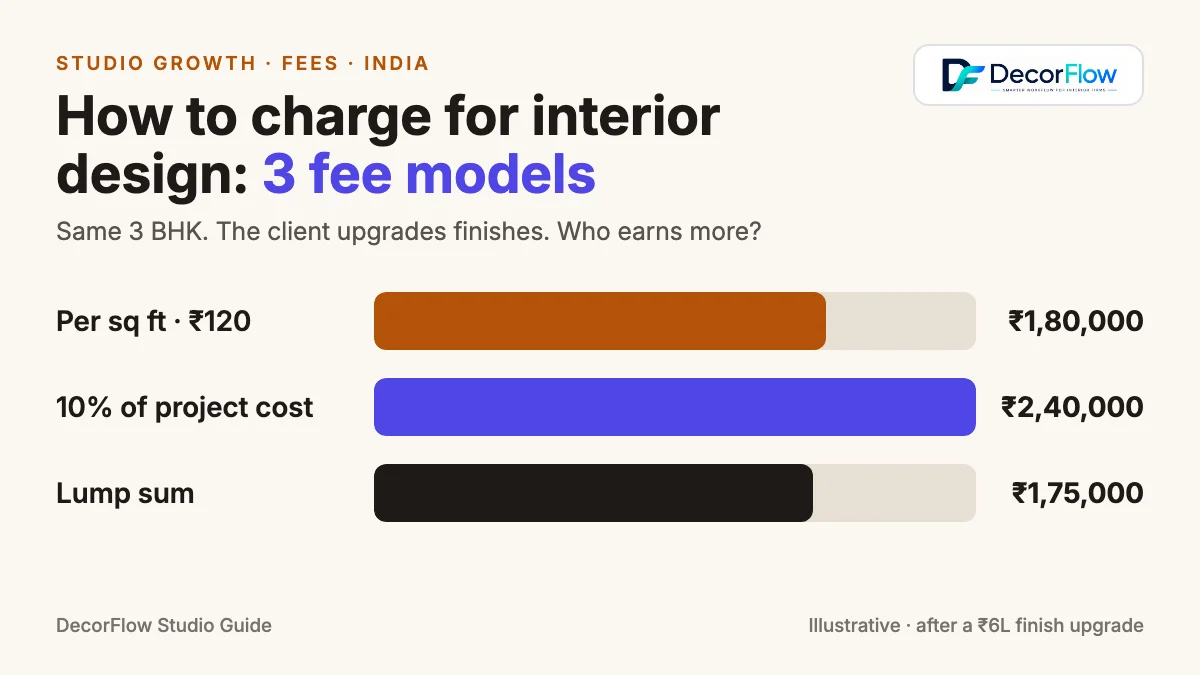
Illustrative figures. A 3 BHK apartment, 1,500 sq ft carpet area. The studio estimates execution at ₹18,00,000. Halfway through design, the client upgrades the kitchen and wardrobes, and execution rises to ₹24,00,000. The drawings and site visits barely change.
| Fee model | Fee at original scope | Fee after upgrades | What happened |
|---|---|---|---|
| Per sq ft (₹120/sq ft) | ₹1,80,000 | ₹1,80,000 | Same area, same fee |
| Percentage (10% of execution) | ₹1,80,000 | ₹2,40,000 | Fee rose with spend, not with work |
| Lump sum | ₹1,75,000 | ₹1,75,000 | Same, unless the contract allows a revision |
Under the percentage model the fee rises by ₹60,000 although the design work barely changed. That is exactly why some clients distrust percentage fees. Under the lump-sum model, if the upgrade had also meant new drawings and two more rounds of 3D views, the studio would carry that cost unless the contract caps revisions.
How to set your number: work back from cost
Whichever model you use, work out what the project costs your studio to deliver first:
List the deliverables: measured drawings, layout options, 3D views per room, working drawings, BOQ, site visits during execution.
Estimate hours per deliverable for each person (principal, designer, draughtsperson, site supervisor).
Multiply by each person's cost per hour (salary plus overheads, divided by billable hours).
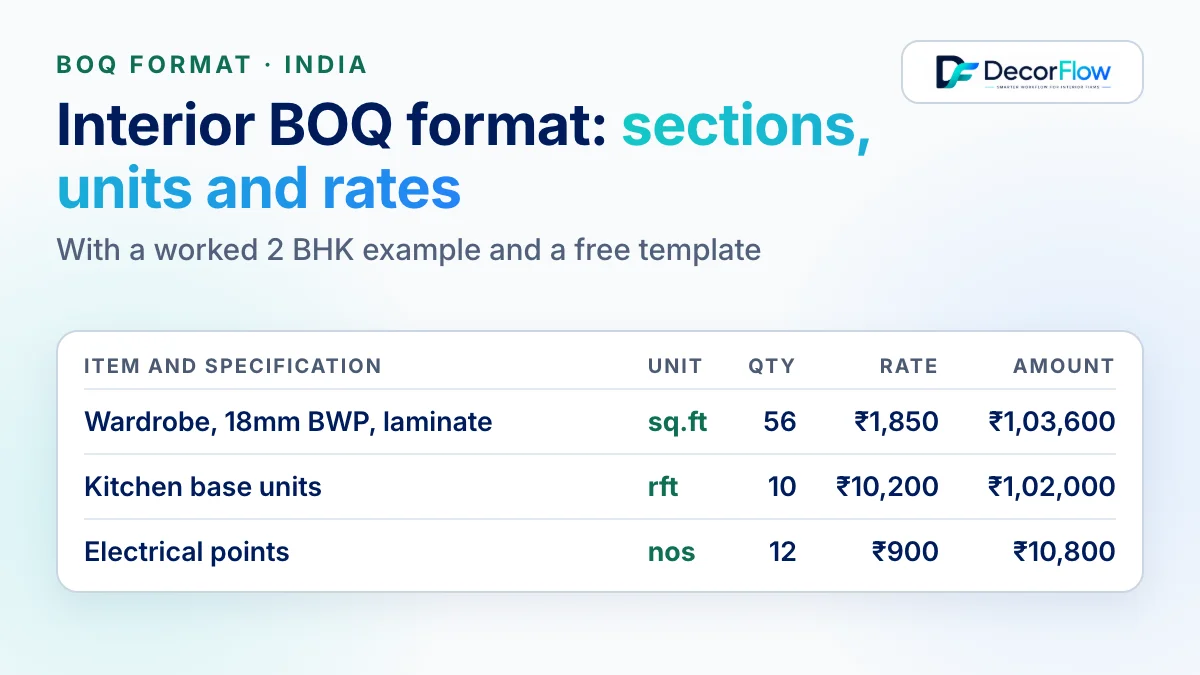
Add your target margin. Our BOQ guide explains the difference between markup and margin; don't confuse the two when you set the fee.
Convert the total into the model you present: divide by area for a per-sq-ft rate, by the expected execution value for a percentage, or keep it as a lump sum.
Doing this once for your three most common project types (2 BHK, 3 BHK, villa or office) gives you rates you can defend instead of matching the last competitor's quote. See markup vs margin in the BOQ format guide.
The hybrid most design-and-execute studios use
Turnkey studios often charge a design fee (per sq ft or lump sum, paid against design milestones) and earn a margin on execution built into BOQ rates. The design fee pays for the work done before any material is ordered; the execution margin pays for procurement, supervision and the risk of running the site.
Charge the design fee even when the client will also give you the execution. It filters out clients collecting free designs to take to a cheaper contractor.
Some studios adjust the design fee against the execution order once the client signs for execution. Write this down so the client knows exactly when it applies.
Keep the execution margin in the BOQ, not as a separate line the client can negotiate away.
In DecorFlow, BOQs carry a target margin, and the quotation built from the BOQ shows the client rates, discounts and GST. See BOQ software.
Clauses that protect any fee model
- Scope: the rooms and deliverables included, and what is not included (civil work, loose furniture, appliances)
- Revisions: the number of layout and 3D revision rounds included, and the charge for extra rounds
- Site visits: the number included during execution, and the charge per additional visit
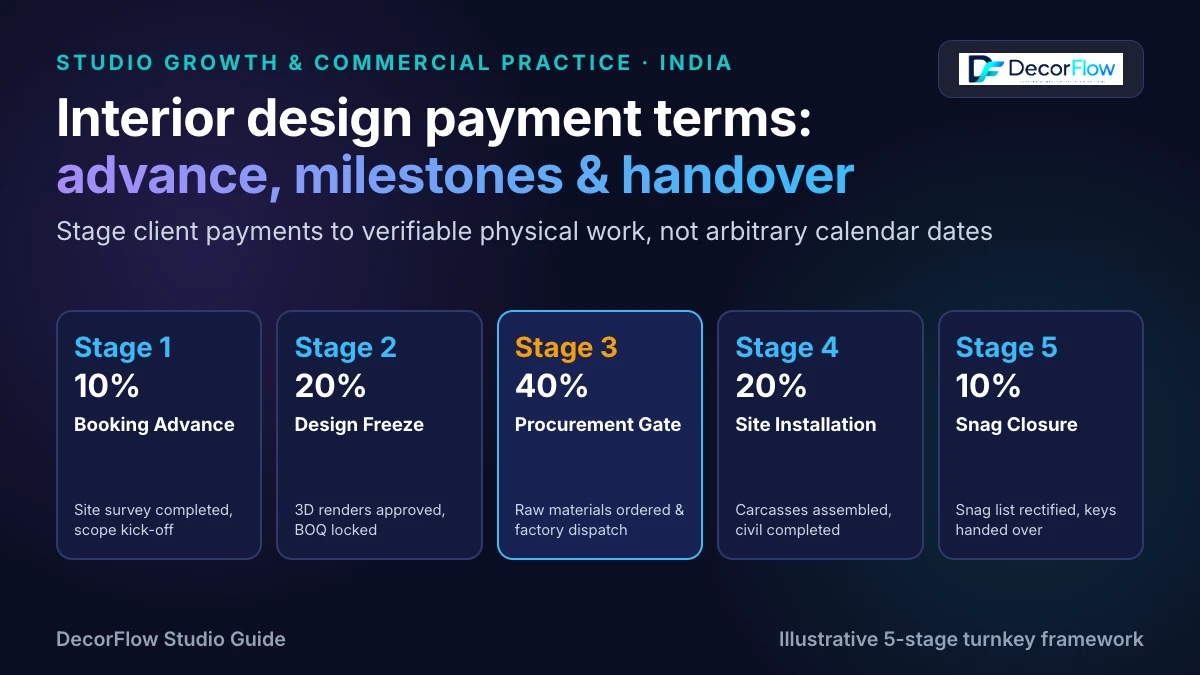
- Payment stages: each payment tied to a finished deliverable, not a date
- Change in scope: how the fee changes if rooms or area are added
- GST: whether the fee is inclusive or exclusive of 18% GST
- Cancellation: what is payable for work completed if the client stops the project
Payment stages deserve their own discussion; the interior design payment terms guide covers how to tie each stage to finished work. For GST on fees, see GST on interior design services.
Presenting the fee so clients accept it
Show what the fee buys: list deliverables and visits, not just a number.
Give one recommended option, and at most one smaller alternative (for example, design without execution supervision).
Put the fee and the payment stages on the same page.
Explain how you will handle changes before the client asks.
Common questions
Sources
Asian Paints Beautiful Homes: cost of hiring an interior designer, checked 25 Oct 2026
Nitido Design: how do designers charge, checked 25 Oct 2026