
Ask a studio owner why a 3 BHK job slipped by three weeks and you will hear about carpenters, painters or the monsoon. Open the project file afterwards and the cause is often earlier: a finish chosen late, a drawing revised after cutting began, a flat that was not really ready on day one, or a delivery that came short and nobody noticed for four days.
This guide covers the handful of handoffs where interior projects lose days, and what a studio can put in place for each one: a scope freeze, a decision calendar, materials planned as a schedule, a written trade sequence, changes priced in rupees and days, and a weekly update. It is written for studio owners, project managers and site supervisors running residential and small commercial jobs in India.
Where interior projects actually lose days
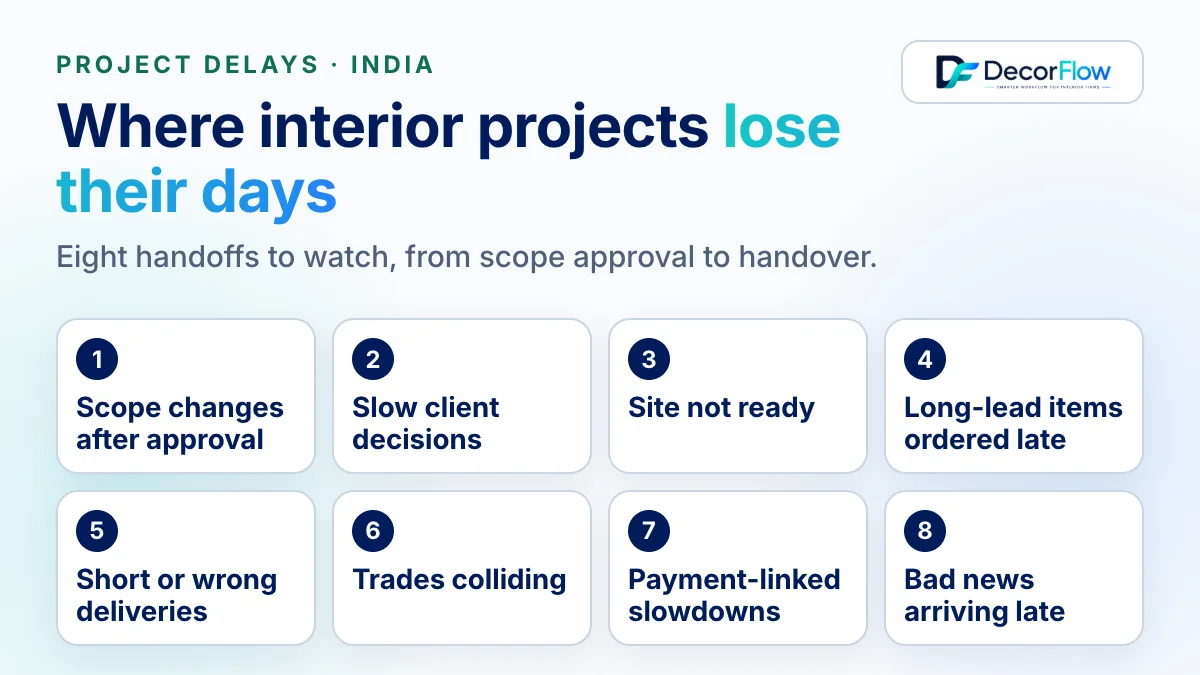
Delays rarely have a single cause. The table lists eight handoffs where schedules commonly slip, the warning sign that usually shows up first, and the fix. Many of these warning signs show up before the date actually moves.
| Where days are lost | Early warning sign | What to put in place |
|---|---|---|
| Scope changes after approval | "Can we just add..." after drawings are signed | Freeze scope; every change becomes a priced, dated variation |
| Slow client decisions | Selections still pending after the agreed date; the same question asked three times | A decision calendar with dates, sent in writing |
| Site not ready | Previous trade still working; society permission or lift booking pending; point positions unmarked | A site-readiness check before the start date |
| Long-lead items ordered late | Orders placed after civil work has begun | Order from the approved BOQ and write the vendor's lead time on the PO |
| Short or wrong deliveries | Material arrives but quantity or finish does not match the order | Receive against the PO on the day and record shortfalls |
| Trades colliding | Painter and carpenter in the same room; electrician waiting for ceiling framing | A written trade sequence with one owner per room per day |
| Payment-linked slowdowns | Work slows when a stage payment is pending | Tie payment stages to visible milestones and invoice on completion |
| Bad news arriving late | The client hears about the slip in handover week | A weekly update; every delay reported with a revised date |
Freeze scope before the first wall is touched
A schedule is only as stable as the scope behind it. Before execution starts, get the following in writing and make sure the whole team is working from the same revision.
- Quotation approved by the client, with the version number recorded
- Working drawings issued with revision numbers, and older printouts withdrawn from site
- Electrical, plumbing and AC point positions confirmed on the drawing and marked on site
- Finish, laminate, hardware and fixture selections signed off
- Site measurements checked against the drawings before any factory cutting
- Society permissions, working hours, lift booking and debris rules confirmed
- One named person on the client side who gives decisions
Measurements sit underneath all of this. Capturing rooms on site once and carrying them into costing removes one common source of rework; a site survey workflow is built for exactly that.
Build a decision calendar with the client
Client decisions are among the most controllable causes of delay, because the studio knows in advance which decision blocks which trade. Work backwards: for each trade, list what must be decided before it starts, then give the client a date for each in writing at the start of the job.
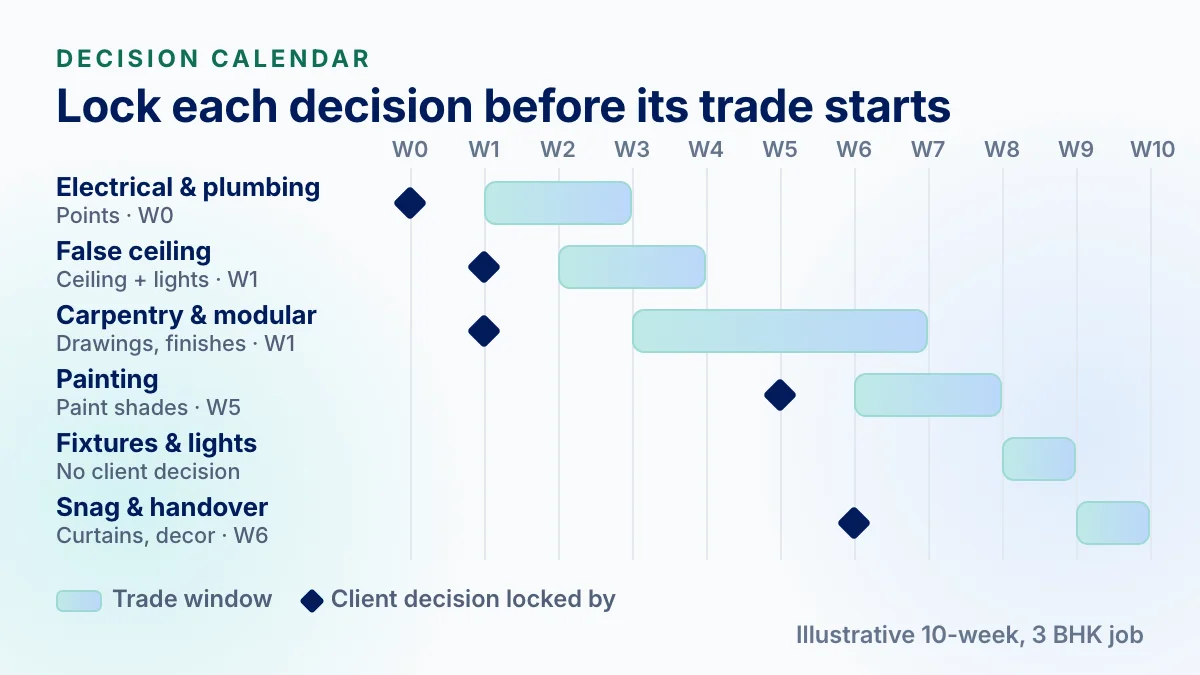
The table below is an illustrative calendar for a 3 BHK turnkey flat planned over about ten weeks, where week 0 is the day the site is handed over to the execution team. Your durations will differ; build yours from your last few completed jobs.
| Decision | Lock by | What it blocks |
|---|---|---|
| Electrical and plumbing point positions | Week 0 | Chasing, concealed wiring and pipework |
| False ceiling and lighting layout | Week 1 | Ceiling framing and electrical rough-in |
| Carpentry and wardrobe drawings (with revision number) | Week 1 | Factory cutting and site carpentry |
| Laminate, veneer and hardware: brand, finish, quantity | Week 1 | Purchase orders for the longest-lead items |
| Paint shades and wall finishes | Week 5 | Putty and painting |
| Curtains, loose furniture and decor | Week 6 | Final installation and handover |
Put the consequence in the same message as the date: "If paint shades are not final by week 5, painting starts a week late and handover moves by a week." Send a reminder two days before each date and keep the reply on record.
Plan materials as a schedule, not a shopping list
Materials often delay a job not because the vendor is slow, but because the order went in after the work that needed it. Treat procurement as part of the schedule.
Turn the approved BOQ into a requirement list grouped by trade, with the date each item is needed on site.
Ask every vendor for a lead time in writing and put it on the purchase order.
Order the longest-lead items first: special laminates and veneers, specific hardware, stone, fabric and custom fixtures.
Receive against the PO on delivery: count, finish and damage, with photos. Record a shortfall the same day.
Give the supervisor a short "arriving this week" list so nothing surprises the site.
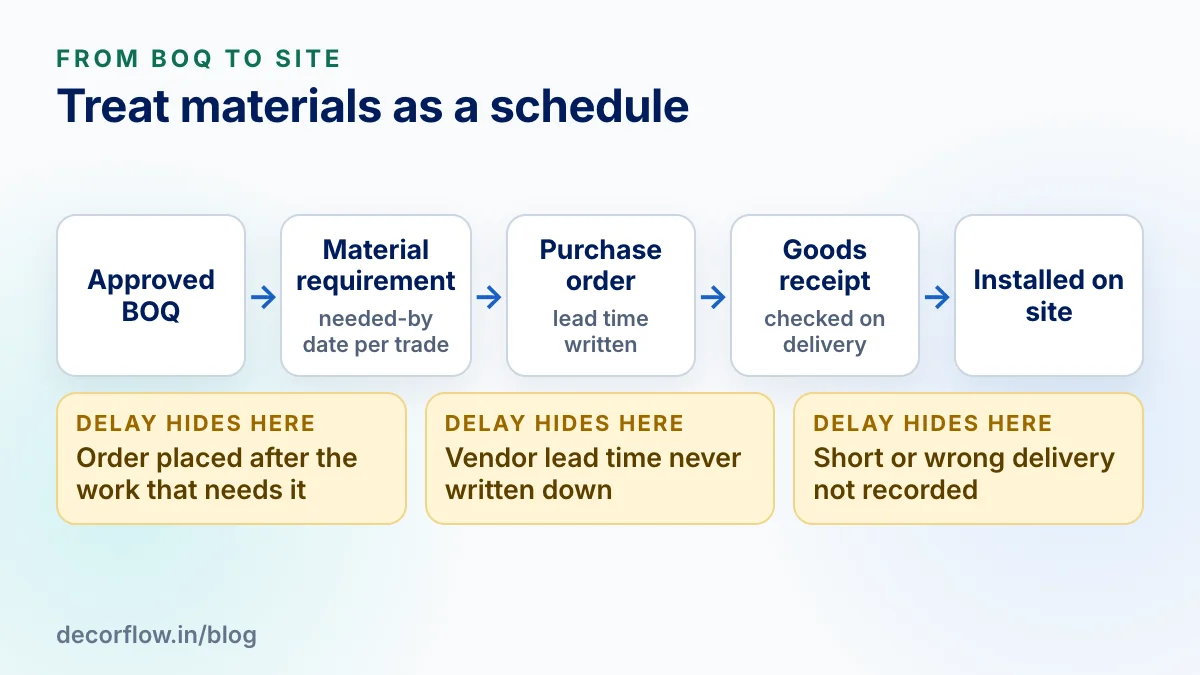
In DecorFlow procurement, material requirements are generated from the approved BOQ, purchase orders can be raised and revised, and goods receipt notes are recorded against each order, so a PO shows as not received, partly received or fully received. A short delivery becomes visible on the day it arrives instead of in the middle of the carpentry stage.
Write the trade sequence down
Trades collide when the order lives in the supervisor's head. Write the sequence, share it with every contractor and give each room one owner per day. A typical order for a residential flat looks like this, though wet areas and tiling will change it:
Civil alterations and waterproofing
Electrical and plumbing rough-in
False ceiling framing and services
Carpentry and modular installation
Putty and painting
Fixtures, lights and switch plates
Deep clean, snag list and handover
The sequence is also where you check readiness. Before a trade starts, confirm the previous one is signed off, the room is clear, and the materials for the new trade are on site.
Price every change in rupees and in days
Most studios price a change in rupees. Few state what it does to the date, and that is what the client forgets. For every change after approval, write down what is added or removed, the rupee impact, the days it adds or saves, and get the client's confirmation before the work begins.
An illustrative example: after drawings are approved, the client asks for a pooja unit in the living room. The variation reads "add pooja unit, +₹68,000, +4 working days, new handover date confirmed in writing." Once it is written like that, the client can choose to proceed, trim the scope or accept the new date.
DecorFlow's quotation change orders record a variation against the approved quotation (add, modify, remove, or a site-condition change) and calculate the net change and the timeline impact in days, then sync the change back to the BOQ.
Tell the client early, with a new date
Clients usually take a delay better than a surprise. A habit that helps is a short weekly update that always contains the same four things: what finished against plan, what is pending from the client and by when, any change to the handover date, and photos from site.
With project management in DecorFlow, the studio keeps milestones with planned and completed dates and posts progress updates with photos. Clients see those updates in the client portal, where they can also approve designs and quotations or send them back with revision notes, so approvals leave a record instead of living in a chat thread.
A weekly delay review
Once a week, with the project manager and supervisor, go through these questions. Keep it short; it works best when the answers are already on paper.
- Which milestones were due this week, and which are finished?
- Which client decisions fall due in the next two weeks?
- Which materials are due on site this week, and was anything received short?
- Which trade starts next week, and is the room ready for it?
- Which changes were requested, and are they priced in rupees and days?
- Has the handover date moved, and has the client been told?